
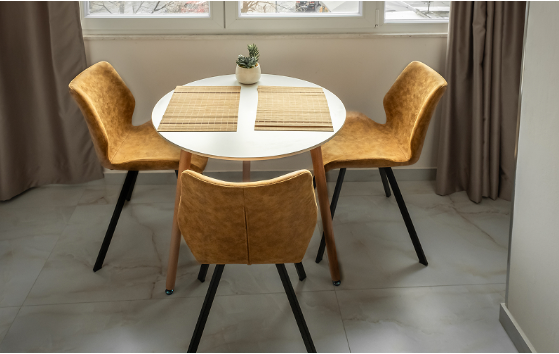

Travertine has become a popular choice for homeowners who want a dining table with natural texture and a warm, timeless look. However, in many HDB flats, the dining area is compact and often shares space with the living room or kitchen, which raises the question of whether a heavy stone table is practical. Fortunately, in most cases, a travertine dining table can work in a small HDB dining area, as long as the size, shape, base and finish are chosen with the space in mind.
Challenges of Fitting Stone Into a Compact Dining Area
Before shortlisting tables, it helps to understand what makes smaller HDB dining spaces tricky for stone furniture. Common considerations include these:
- Limited floor space, especially where the dining area sits between the kitchen and living room.
- Walkways that need to stay clear for daily movement around the flat.
- The visual weight of a solid stone top, which can make a small room feel crowded.
- The physical weight of travertine, which affects delivery and moving it later.
- Daily use, as many households eat, work and gather around the same table.
Making a Travertine Dining Table Work in an HDB Flat
Each of these challenges can be managed with the right choices. The sections below cover the main decisions that help a stone table suit a smaller space.
Choosing a Size and Shape for Compact Spaces
Round and oval tables often suit small HDB dining areas better than rectangular ones, as they have no sharp corners and allow easier movement around the table. A round table of around 90 to 100 cm in diameter typically seats four people comfortably. Leaving roughly 75 to 90 cm between the table edge and walls or other furniture gives enough room to pull out chairs and walk past.
Planning for Weight and Delivery
Travertine is dense, and even a compact tabletop can be heavy to lift. That said, before buying from a furniture shop in Singapore, it is worth asking whether delivery includes carrying the table up to the unit and assembling it, how many movers will be needed and whether the top can be separated from the base. Measuring the lift, doorways and corridor turns in advance can help avoid problems on delivery day.
Selecting a Base That Saves Space
The base has a big effect on how much room the table takes up. A single pedestal base frees up legroom and allows chairs to tuck in closely, which is useful in tight spaces. Slim metal legs can also make the table look lighter, while bulky block bases may feel too heavy for a small room.
Keeping the Room Feeling Open
Light travertine shades such as ivory or beige reflect more light and help small spaces feel brighter. Pairing the table with slim or open-backed chairs, a light rug and minimal surrounding furniture prevents the dining corner from looking cluttered. A pendant light hung over the table can also define the dining zone without taking up floor space.
Protecting the Surface for Everyday Meals
Travertine is porous and can be marked by acidic foods and drinks such as citrus, vinegar, wine and coffee. A sealed or filled finish helps resist stains, and resealing periodically, as advised by the supplier, maintains protection. Using placemats and coasters and wiping up spills promptly are simple habits that keep the surface looking its best.
When a Smaller Alternative May Suit Better
If space is very tight, a compact bistro-sized travertine table, a travertine-topped console that doubles as a dining surface or a table with a travertine-look top in a lighter material may be easier to live with.
Fitting Stone Into a Smaller Home
A travertine table can suit a small HDB dining area when its size, shape, base, colour and finish are chosen carefully. Measuring the space, planning delivery and protecting the surface from daily wear help the table remain practical as well as attractive for years to come.
Reach out to Cellini to shop our compact travertine dining tables for smaller homes.