
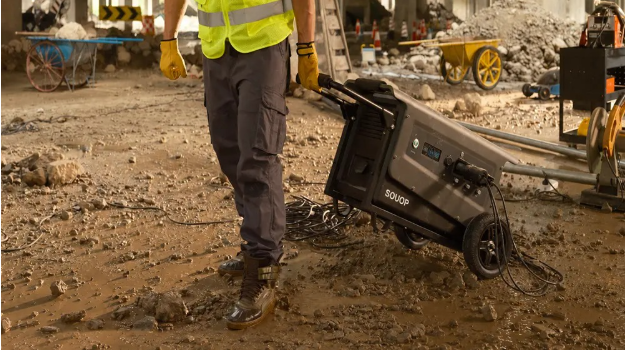

Whether a crew is demoing the interior frame of a residence, prepping the circuit system of a full home remodel, or just building a new outdoor deck, the speed at which the entire process occurs is dictated by the amount of power being used.
Historically, the two options at a jobsite to power tools and equipment are either running long extension cords to a power source or using heavy, loud gas generators to supply needed electricity.
Both options lead to safety risks and a loss of productivity. Today, there’s a better way. With battery technology advancing by leaps and bounds, contractors everywhere are beginning to adopt the high capacity Industrial Power Station as the preferred method of jobsite power.
Below are a few reasons why professional remodeling and construction contractors are choosing advanced power stations as their equipment of choice.
The Challenges of Jobsite Power
Before diving into the technical specs, it’s important to address the actual conditions these high capacity power stations must function in while serving as a power supply for contractors. It should come as no surprise that jobsites are much more demanding environments than your average camping trip or backyard job.
Fine Dust, Particles, and Debris
It’s no secret that remodeling and construction produce copious amounts of fine dust. Consumer level power banks commonly feature fans and vented covers to help cool down internal electronics. While this method works for the average user, the fine dust produced at a jobsite infiltrates the cracks and crevices of the power station, shorting out internal circuitry and damaging internal fans. A specialized waterproof power station is required to keep out pesky dust and debris in order to prevent jobsite downtime.
Moisture and Environmental Hazards
Contractors can’t wait for the sun to come out on a cloudy day at a jobsite. Additionally, working in unfinished basements or crawl spaces expose tools and equipment to high humidity and the potential for water spills. A specialized unit will protect internal electronics from dust and moisture, keeping projects running smoothly.
6 Key Features of Jobsite Power Stations
High power stations utilize cutting-edge battery technology and powerful inverter systems to provide commercial grade power for the modern-day jobsite. Below are key technical specs for an industrial battery powered power station:
1. High Capacity with High Performance AC Pure Sine Wave Inverter (5,040Wh | 5,000W AC Pure Sine Inverter)
While most consumer-grade power stations max out at 1,500Wh with no AC inverter, industrial power stations can support numerous power tools at once and include a 5,000W AC Pure Sine Wave Inverter (with 7,000W surge). This combination allows the unit to easily support power intensive tools and equipment such as table saws, miter saws, high-power shop vacuums, and multi-bay battery chargers all at the same time.
Pure Sine Wave Inverters replicate the smooth current of standard household outlets, eliminating the risk of damaging sensitive electronics. Modern power tools, laser levels, and survey equipment all have complex microprocessors that can be damaged by the rough electricity produced by most gas-powered inverters. An AC Pure Sine Wave Inverter protects these fragile items from potentially damaging power surges.
2. Quick Charging (0 to 100% in 1.5 Hours)
Lost productivity means lost revenue for contractors. Power stations with 8 hour charge times become completely depleted in the middle of the work day at best and cause jobsite downtime at worst. Fortunately, industrial grade power stations utilize state-of-the-art battery technology and power management systems to provide a full charge in only 1.5 hours. After a lunch break, the power station is fully charged and ready for the afternoon session of work.
3. Expandable Capacity to 45.36kWh
The power needs of a remodeling and construction crew varies drastically depending on the size of a particular jobsite.
Small bathroom remodels need drastically less power than large-scale jobs that last for several weeks at a time. To meet the requirements of both types of jobs at a reasonable cost, contractors can expand the base 5,040Wh unit (1,008,000 mAh) by adding 8 B5 expansion units at a time for a total system capacity of 45.36kWh (9,072,000 mAh). At this level, the power station can serve as an off-grid power grid for an active jobsite, capable of running for several days at a time.
4. Smart HD LCD Display
Having the power die out at the worst possible time, such as in the middle of cutting a piece of custom molding, is a waste of time and money.
The Smart HD LCD Display on an industrial power station allows job leads to know exactly what is going on at all times. At a glance, contractors can tell:
- How much power is currently present within the unit
- How many watts are flowing in during charging
- How many watts are flowing out during discharge
- How much longer the current charge will last at the current rate of discharge
This eliminates the guesswork from jobsite power management by removing the need to calculate the rate of discharge based on how long a particular tool draws power.
6 Ways to Charge an Industrial Power Station
Power stations are only useful if they can get power. Fortunately, an provides 6 different ways to recharge its internal battery:
- AC Charging: Standard AC wall outlets are utilized when prepping for the day.
- Solar Charging: Solar panels can be used to provide free power when working on a jobsite in isolation.
- Car Charging: Contractors can recharge the battery on the work van or truck when driving to a new jobsite.
- AC and Solar Simultaneous Charging: Contractors can combine the input from solar panels and standard AC during simultaneous charging, maximizing input speeds.
- Gas Generator Fast-Charge: Gas generators can be used to quickly charge the power bank before shutting them off and continuing on with work uninterrupted.
- EV Charging and Anderson Inputs: Public EV charge ports can be used in urban centers while specialized Anderson inputs are used to keep the power flowing in more industrial conditions.
Commercial Grade LiFePO4 Chemistry for Lasting Power
Contractors and remodelers can’t afford to purchase new equipment after every year or two due to normal wear and tear. Consumer level power stations utilize Lithium Nickel Manganese Cobalt Oxide (NMC) cells that generally last between 500-1,000 cycles before needing to be replaced.
In contrast, industrial power stations utilize cutting-edge Lithium Iron Phosphate (LiFePO4) chemistry that offer immense benefits at a jobsite:
3,500+ Cycles to 80% Capacity
Even with daily use, these batteries will retain 80% of their original capacity after almost 10 years of daily use.
Superior Chemical and Thermal Stability
LiFePO4 cells possess superior safety characteristics compared to many other lithium battery technologies. They’re exceptionally resistant to both thermal runaway and overheating, making them ideally suited for enclosed environments such as residential buildings, basements, and work vans.
UPS (Uninterruptible Power Supply) 2,200W Max
During major home remodels, power to the structure in question often gets shut down or altered to accommodate the needs of the job.
This poses a risk to precision tools and delicate electronics that can be damaged when power goes out unexpectedly.
Fortunately, the built-in 2,200W Max uninterruptible power supply serves to buffer power supply fluctuations from the wall outlet. Under normal circumstances, power simply flows through the battery uninterrupted. However, during a blackout, the circuit seamlessly switches over to the built in battery to prevent downtime and power loss for delicate equipment.
Jobsite Usage Scenarios
Having reviewed the technical specs, it’s time to review exactly how an industrial power station would be used on a daily jobsite. Below are a few examples of how a high-capacity power station would see regular use:
Interior Jobs
Running long, tripping hazards of extension cords through doorways, up and down stairs, and inside rooms can be incredibly dangerous. It also presents a risk of damaging the client’s walls and furnishings at the jobsite. By using a self-contained waterproof power station inside the working area, a contractor can remove tripping hazards and keep the client’s property safe from unsightly marks and scratches.
Exterior Jobs
Working on decks, roofing, and masonry jobs commonly means running extension cords across lawns and sidewalks. The additional distance causes voltage drops, starving power tools of electricity and causing undue stress on the motor. Additionally, power stations allow for short, direct cords to reach power, eliminating voltage loss.
Rewiring Jobs
During whole home rewires, electricians turn off main power to the structure being worked on. This completely shuts down the home until temporary power can be brought in. This process is both time consuming and dangerous while introducing fumes to the jobsite. By deploying an industrial power station, contractors can bring in power for lights, tools, and even saws without risking the safety of the jobsite.
Equipment Efficiency & Profit Margins
In commercial construction, time equals money. Anything the crew does that doesn’t directly bill to the client cuts into the bottom line.
By switching to a battery powered jobsite power station, contractors can enjoy the following benefits:
- Fewer Noise Restrictions: Most municipalities place noise restrictions on gas generators, limiting their use to between 8AM and 5PM. Battery powered power stations operate completely silent, eliminating these noise restrictions altogether.
- Increased Equipment Longevity: Pure Sine Wave inverters greatly reduce stress on the delicate electronics and motors of power tools, prolonging their useful lifespan.
- No Emissions: With no emissions, contractors can work inside enclosed and residential jobsites without worrying about fumes or the safety of the work area.
Modern day contractors and remodelers need to get more done in less time while utilizing equipment that lasts for years at a time. By adopting a state-of-the-art Waterproof Power Station, remodeling contractors maximize jobsite power while protecting their valuable equipment.